Spring syllabi posted

I have added this semester’s syllabi to my teaching history page. All three are repeats, making this the first semester in many years when I have not had a fresh prep.

Ethics (philosophy department): This course is my showcase for translating the primary text-based format of the Shimer Great Books School into a large lecture class. My biggest innovation here was to hold them accountable for the reading by requiring them to upload images of their annotated pages. I further motivate them to engage with the text by making all exams open-book, but only for print books (except in case of an accomodation, which has not occurred so far). Last year’s iteration was very successful, so I am not changing much this time around.

Gaming the System: Alternatives in Math and Logic (Shimer): Last fall I taught this course for the first time, which put me on the home stretch toward my goal of teaching the entire Shimer Great Books curriculum. After teaching a new class for the first time, I always like to teach it again the following year so that my mistakes are fresh in my mind. This is probably my most significant revision this semester, drawing on a great deal of reading and research in the year and a half since I last taught it.

Deals With the Devil (Shimer): A version of this course, centered on the Faust legend, was a staple offering for me for several years when we first arrived at North Central. Last year I offered it for the first time in the Shimer program after a period of dormancy, and I realized that I was spending too much time trying to replicate my argument in The Prince of This World and delving far too much into the enigmatic Part 2 of Goethe’s Faust. This time around, I have trimmed those aspects and taken advantage of the additional time gained to transition into more of a film class format in the second half of the semester, when they will be working on their research papers.

Advance Praise for Late Star Trek

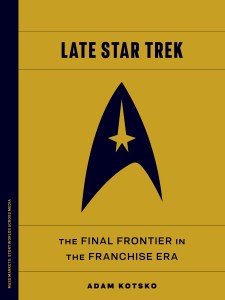
I have received the endorsements that will appear on the back cover of my forthcoming book, Late Star Trek: The Final Frontier in the Franchise Era, which is available for preorder directly from the press, from Bookshop.org, or from the Evil Empire. Both are from path-breaking scholars of Star Trek, so they mean a lot!

“Combining the rigorous critical eye of a literary and political theorist and the encyclopedic knowledge of a devoted fan, Adam Kotsko offers an original, persuasive, ethical, funny, grim, and nevertheless hopeful examination of Star Trek’s twenty-first-century incarnations. Late Star Trek is a salutary intervention, a sustained, cogent analysis of what’s gone wrong, what’s gone right, and what possibilities remain for creative and critical storytelling in our late-neoliberal streaming era.” —David K. Seitz, author of A Different Trek: Radical Geographies of Deep Space Nine

“Adam Kotsko has written an eminently readable and deeply researched book on twenty-first-century Star Trek, providing an analysis that is both timely and long overdue. A must-read for anyone teaching, doing research on, or just thinking about this ever-growing franchise.” —Sabrina Mittermeier, coeditor of The Routledge Handbook of Star Trek and Fighting for the Future: Essays on “Star Trek: Discovery”

New book contract

I’m pleased to announce that I have signed a contract with Taylor & Francis to write a book entitled Political Theology: The Basics, which will be part of a series of introductory works intended for undergraduates. My goal in writing the book is to present both major strains of what is called “political theology” — politically-engaged theology as well as the genealogical political theology I usually practice — within a unified historical framework. I plan to deliver the manuscript in Fall of 2026. Thank you to Beatrice Marovich for recommending me as a possible author for this project.

Fall syllabi posted

I have belatedly added my Fall syllabi to my teaching history page. They are as follows:

What is Life? (syllabus): This is a Shimer seminar on the history of biology and evolutionary thought. I have been expanding my teaching competence in the history of science over the last few years, and this is the second-to-last course I needed to complete Shimer’s entire Natural Sciences curriculum.

Logic and Critical Thinking (syllabus): For reasons I have discussed elsewhere, formal logic has become a staple course for this dyed-in-the-wool continentalist. After a few years, this has become fairly routine — but I chose to switch from Copi/Cohen to Hurley this year, as the former has too many misprints and poorly designed problem sets. Hurley is proving superior in most ways.

Star Trek and Social Justice (syllabus): This is a half-semester seminar offered for students in North Central College’s Honors Program. Last year I offered one on Watchmen (both the original comic and the HBO series), and it went so well that I decided it was time to put together something in my core area of pop cultural expertise. I opted to center the course on the first season of Discovery, which is unique in being a pretty self-contained serialized narrative and rewards analysis even more than most Star Trek does.

New Substack: Late Star Trek

To help promote my forthcoming book and to give me somewhere to put my many thoughts about Star Trek in general, I have started a new Substack, also entitled Late Star Trek. You can read the first post here.